Civil Rights in the White Literary Imagination by Gray Jonathan W
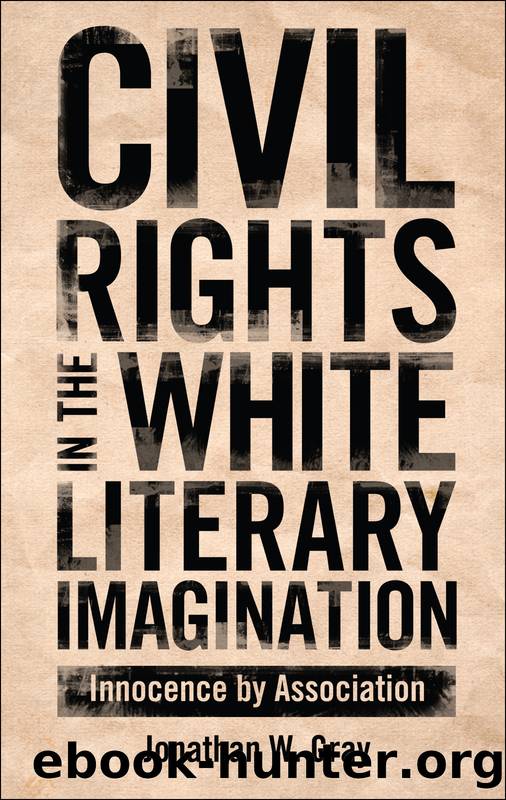
Author:Gray, Jonathan W.
Language: eng
Format: epub
Publisher: University Press of Mississippi
Published: 2013-08-14T16:00:00+00:00
Chapter Four
“NEGROES, AND BLOOD, AND HORROR”
William Styron, Existential Freedom, and
The Confessions of Nat Turner
For those who lived through it, 1968 must have seemed like an apocalyptic year, a year that perhaps portended the end of the American experiment. On Thursday, April 3, 1968, just four days after Lyndon Johnson announced that he would not seek reelection, Martin Luther King was murdered. Towards the conclusion of that same April, as urban centers throughout the nation struggled to assess the damage from the riots that followed King’s assassination, Students for a Democratic Society began what would become the takeover of Columbia University. Then, on June 5, as the nation and the media were attempting to grasp the implications of a suddenly militant student movement, Robert Kennedy was gunned down while campaigning in California. A summer of unrest and uncertainty followed the King and Kennedy assassinations, and in August the Democratic National Convention degenerated into what Norman Mailer aptly described as the siege of Chicago. That same August, Beacon Press published William Styron’s Nat Turner: Ten Black Writers Respond, a collection of essays edited by distinguished historian John Henrik Clark.
The publication of a collection of essays critiquing a literary work seems to pale in comparison to the other events listed above. Yet the controversy that resulted from this response to William Styron’s Pulitzer Prize–winning novel, the conflict between supporters of The Confessions of Nat Turner and those who endorsed the reply from the Ten Black Writers, neatly parallels the other problems afflicting the nation. To liberal thinkers and academics, the Ten Black Writers represented the logical end of the more militant strains of the civil rights movement that had infected the student movement: an ideological thought police that restricted artistic and academic freedom by demanding a revisionist history that suited their contemporary needs. For those sympathetic to the Ten Black Writers, Styron’s book criminally denied the historical Nat Turner revolutionary agency, diminished the impact of slavery, overlooked the importance of religious thought in Black life, and cherry-picked historical evidence in order to reinforce notions central to white supremacy. For the Ten Black Writers and their supporters any celebration of the novel was a celebration of these themes. Styron’s guise as a transplanted liberal southerner who, by virtue of his upbringing, could sympathize with Black Americans, made his novel’s failure even more reprehensible in the eyes of his critics. The overwhelmingly positive reception of the book, which culminated in the Pulitzer, only confirmed the worst fears of the “militant” scholars who were deeply offended by the novel.
The controversy surrounding Styron’s Confessions of Nat Turner has been amply considered, and I do not seek to rehash the old arguments but rather to trace the role that white racial innocence plays in the construction and reception of this text. Many have written in the aftermath of these two texts, a work of fiction that sought to transform America’s perception of race and the work of criticism that was in some ways more effective in altering racial perceptions than the novel it sought to refute.
Download
This site does not store any files on its server. We only index and link to content provided by other sites. Please contact the content providers to delete copyright contents if any and email us, we'll remove relevant links or contents immediately.
| Anthropology | Archaeology |
| Philosophy | Politics & Government |
| Social Sciences | Sociology |
| Women's Studies |
The Secret History by Donna Tartt(19443)
The Social Justice Warrior Handbook by Lisa De Pasquale(12286)
Thirteen Reasons Why by Jay Asher(9107)
This Is How You Lose Her by Junot Diaz(7044)
Weapons of Math Destruction by Cathy O'Neil(6455)
Zero to One by Peter Thiel(5930)
Beartown by Fredrik Backman(5915)
The Myth of the Strong Leader by Archie Brown(5619)
The Fire Next Time by James Baldwin(5573)
How Democracies Die by Steven Levitsky & Daniel Ziblatt(5318)
Promise Me, Dad by Joe Biden(5225)
Stone's Rules by Roger Stone(5181)
A Higher Loyalty: Truth, Lies, and Leadership by James Comey(5075)
100 Deadly Skills by Clint Emerson(5016)
Rise and Kill First by Ronen Bergman(4886)
Secrecy World by Jake Bernstein(4861)
The David Icke Guide to the Global Conspiracy (and how to end it) by David Icke(4837)
The Doomsday Machine by Daniel Ellsberg(4608)
The Farm by Tom Rob Smith(4591)
